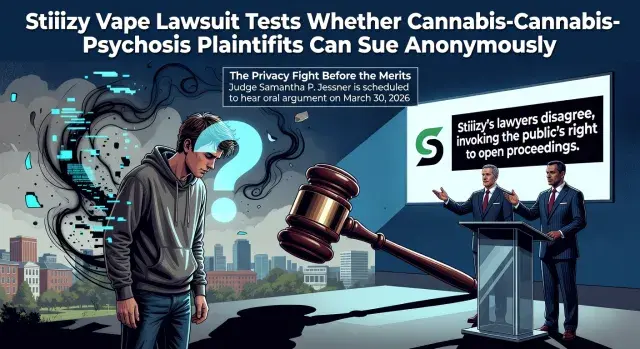
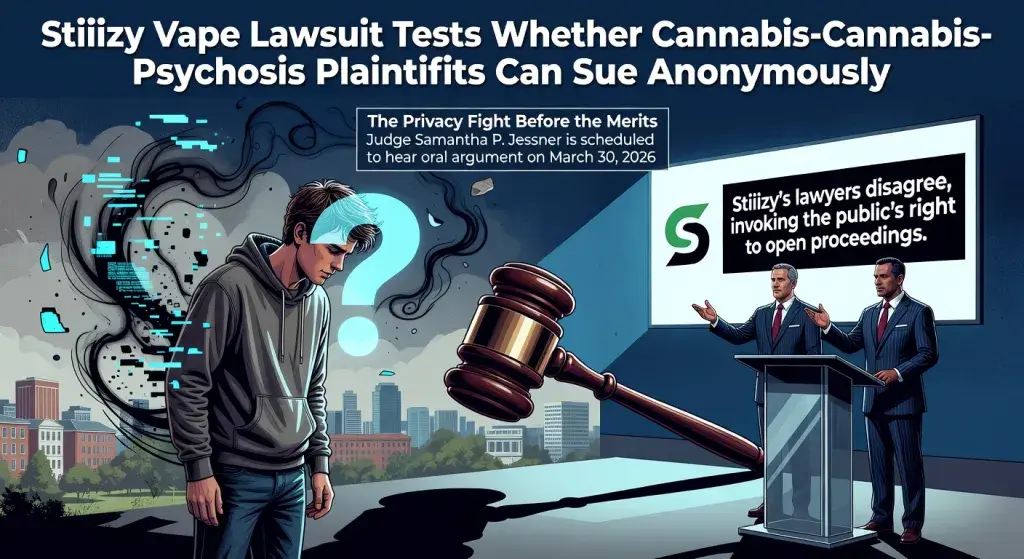
A young man who says Stiiizy's high-potency vape products triggered lasting psychosis is fighting to keep his real name out of court records - and his case could set a template for a growing wave of cannabis-injury litigation in California. The plaintiff, listed as "John Doe" in filings with the Los Angeles Superior Court, argues that attaching his identity to allegations of psychiatric hospitalizations and ongoing mental illness would cause irreparable harm to his education, career, and family. Stiiizy's lawyers disagree, invoking the public's right to open proceedings.
The Privacy Fight Before the Merits
Judge Samantha P. Jessner is scheduled to hear oral argument on March 30, 2026. The question is narrow but consequential: can this plaintiff proceed under a pseudonym? In a sworn declaration first reported by MyNewsLA, Doe wrote that the litigation involves "private medical information, including ongoing mental illness and psychiatric diagnoses," and warned that disclosure could expose his family to threats and harassment. He is, by the complaint's own account, young - he alleges he started using Stiiizy products while still a minor.
Stiiizy's defense team has pushed back hard. Their opposition papers argue that the only evidence of threats so far amounts to hostile online comments directed at Doe's attorneys - not at the plaintiff himself. The defense position, put plainly, is that anonymity would handicap their ability to litigate and that open courts are a constitutional default, not a courtesy. Fair enough as a legal principle. But the tension here is real: cannabis-induced psychosis involves the kind of stigmatized psychiatric diagnosis that can follow a person for decades, and California courts have recognized that stigma as a legitimate factor in pseudonym decisions.
The controlling framework comes from appellate precedent, including Doe v. Lincoln Unified School District, which instructs trial judges to weigh the sensitivity of the information, the plaintiff's age, and the realistic probability of retaliation or harm. Neither side disputes that framework. They just disagree, fiercely, about where the needle points.
What the Underlying Lawsuit Actually Alleges
Strip away the anonymity dispute and you find a civil complaint loaded with claims: fraud, strict products liability, negligence, breach of implied warranty. Filed by a consortium of firms - Rouda Feder, Lieff Cabraser, and Ribera Law Firm - the suit alleges that Doe suffered multiple psychotic episodes, was hospitalized several times, and remains in psychiatric treatment, all linked to what the complaint calls cannabis-induced psychosis from Stiiizy's concentrated THC vaporizers.
The marketing allegations are where it gets pointed. Plaintiffs' lawyers highlight Stiiizy's Pomona store grand opening on June 26, 2021, which featured hip-hop artists Xzibit and Too Short, and a 2024 partnership with Rolling Loud California. The argument: these celebrity tie-ins, combined with sleek device aesthetics and playful flavor branding, amounted to a youth-friendly lifestyle push - one that made high-potency vapes attractive to teenagers and easy to conceal. Stiiizy's own store page confirms the Pomona location and opening date. Whether a jury would find that marketing strategy legally actionable is another matter entirely, but the theory fits within a broader pattern of litigation targeting cannabis companies for allegedly insufficient age verification and youth-oriented promotion.
The Public Health Backdrop
This case doesn't exist in a vacuum. California emergency room visits coded as cannabis-induced psychosis rose from 682 in 2016 to 1,053 in 2019, according to KQED. That's a 54 percent increase in three years - before the pandemic further disrupted substance use patterns and before THC concentrations in commercial vape products continued their upward climb. Industry outlets like MJBizDaily have tracked a series of similar lawsuits against cannabis brands, all circling the same core allegations: too-high potency, too-loose age controls, too-slick marketing.
The clinical reality is that high-THC cannabis products carry a dose-dependent risk of psychotic symptoms, particularly in adolescents and young adults whose brains are still developing. That relationship is well-established in psychiatric literature. What remains contested - and what cases like Doe's will inevitably force courts to examine - is where product liability begins. Is a legal, regulated cannabis product defective because it's potent? Or does liability attach to how it's marketed, labeled, and sold?
What Comes Next
Judge Jessner's ruling on the pseudonym motion won't resolve the merits. But it will signal something. If Doe proceeds anonymously, future plaintiffs with similar psychiatric claims will have a roadmap. If his name is ordered into the public record, it may chill filings from people who might otherwise come forward - particularly young adults with active psychotic disorders and everything to lose from a Google search tying their name to a mental health lawsuit.
Either way, the case adds another data point to an increasingly uncomfortable question for the legal cannabis industry: what duty do brands owe to the youngest, most vulnerable people who end up using their products - even when those products are technically legal and age-restricted? The courtroom in downtown Los Angeles won't answer that question on March 30. But it will decide who gets to ask it, and whether they have to do so by name.