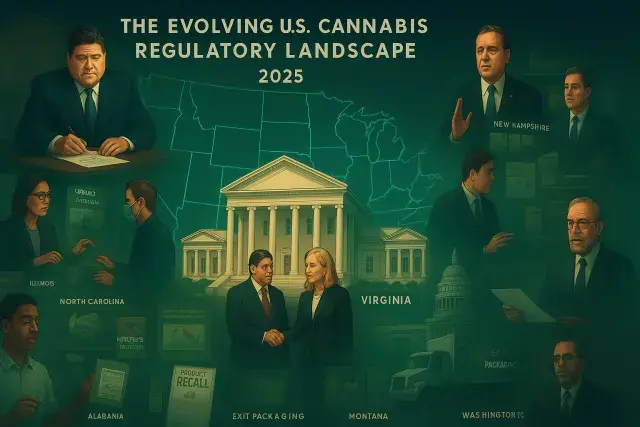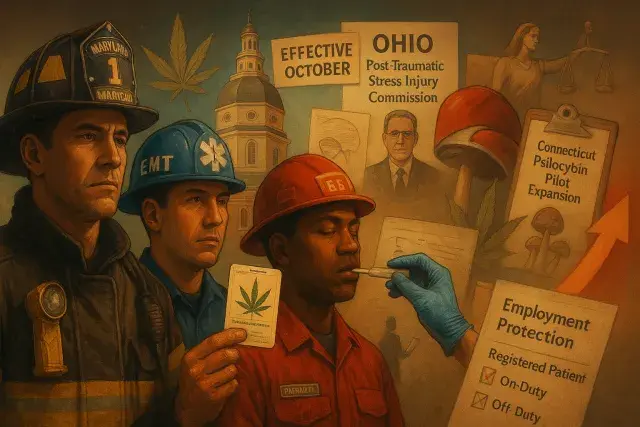
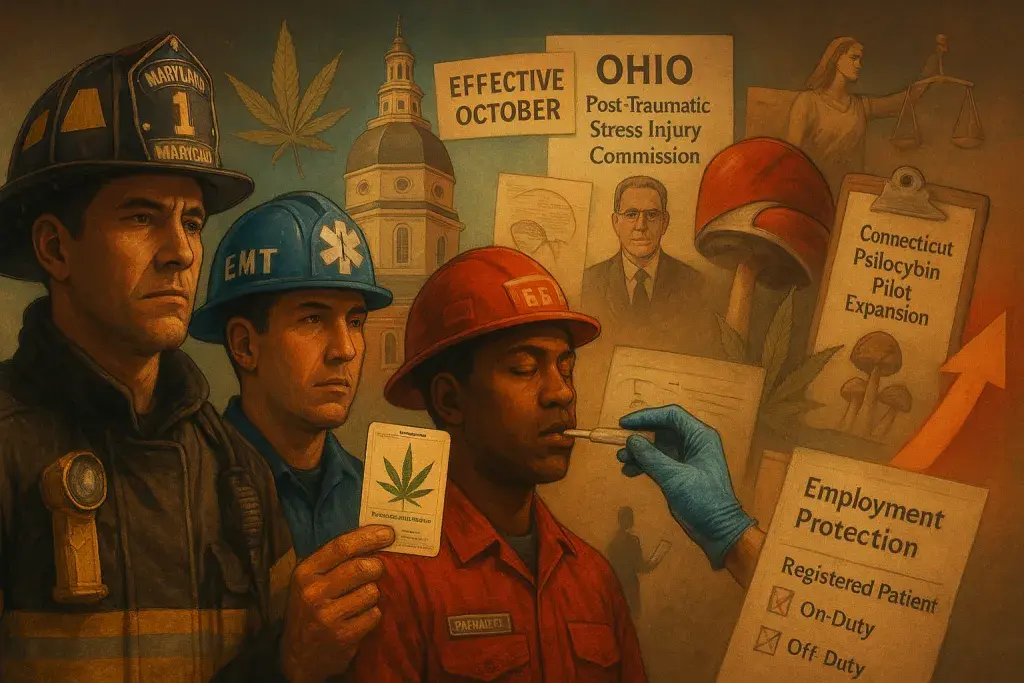
A quiet but accelerating shift is underway in how states address trauma among first responders - and cannabis policy is squarely in the middle of it. From Maryland's new employment protections for medical cannabis patients to Ohio's newly signed Post-Traumatic Stress Injury Commission, legislatures are moving beyond standard clinical frameworks to carve out formal, if still cautious, space for alternative treatment approaches. For licensed cannabis operators and compliance professionals, some of these changes carry direct regulatory implications that are worth tracking closely.
Maryland's law, taking effect in October, is the most immediately relevant development for the cannabis industry. It prohibits employment discrimination against firefighters, emergency medical technicians, paramedics, and other rescue workers who are registered medical cannabis patients and test positive for cannabis metabolites - provided they are not impaired while on duty. That distinction matters enormously in practice. The law draws a line between detection of metabolites, which can linger in a person's system for days after use, and actual on-duty impairment. For dispensaries operating in states that have enacted or are considering similar protections, this reflects a broader regulatory pressure point: the ongoing tension between drug testing protocols rooted in prohibition-era logic and the medical legitimacy of cannabis under state law. Operators tracking state-by-state medical cannabis employment policy - or suppliers working across multiple markets - may find resources like https://indicaonline.com/markets/montana/ useful as they benchmark how individual state regulatory environments are taking shape and diverging from one another.
The Psilocybin Variable - A Signal Worth Reading
Connecticut and Missouri represent a different front. Connecticut's new law expands a Yale University pilot program studying psilocybin-assisted therapy - previously limited to veterans, retired first responders, and frontline health care workers - to any state resident 18 or older who meets the clinical eligibility criteria set by Yale's institutional review board. That's a meaningful expansion of scope, even within the constraints of a supervised research framework. Missouri lawmakers advanced a bill that would allow veterans and first responders in approved research settings to access psilocybin and ibogaine under medical supervision for PTSD and related conditions. The legislature adjourned in May before the bill could reach the governor's desk, so it did not become law - but the fact that it advanced at all signals real appetite for these therapies among lawmakers who might not have touched them five years ago.
Here's the catch for the cannabis industry specifically: psilocybin and ibogaine remain federally controlled substances, just as cannabis does, which means the compliance and research carve-out model being applied to these psychedelics mirrors, in structure, the same arguments cannabis advocates made for years to carve out medical-use protections. The policy logic is parallel even if the substances are different. What states are building here - protected research pathways, employment discrimination shields, commission-based funding for alternative treatment access - is a regulatory template that cannabis operators have seen applied, imperfectly, to their own market. Understanding that template's strengths and failure points matters.
What This Means for Operators and Compliance Teams
For licensed cannabis businesses, Maryland's employment-protection model deserves close attention. As more states adopt or consider similar frameworks, dispensaries and multi-state operators will need to assess how their own HR policies, vendor contracts, and wholesale relationships interact with evolving employment law. A dispensary manager who also serves as a volunteer firefighter, for instance, now operates in a state where his or her off-duty medical cannabis use carries explicit legal protection. That changes internal policy conversations - particularly around employee handbooks, drug testing language, and any contractual obligations tied to federal compliance.
Jason Cerrano, the retired Missouri firefighter and paramedic with more than two decades of experience who now directs commercial research and development at IDEX Fire & Safety, put it plainly in the context this reporting draws from: cumulative trauma exposure in first responder roles causes things that seemed extreme to start feeling normal over time. That psychological normalization of trauma is precisely what the current wave of legislation is trying to interrupt. Whether through psilocybin research, ibogaine studies, or medical cannabis employment protections, states are acknowledging that the standard clinical toolkit - traditional counseling and medication - is not reaching everyone who needs it.
Ohio's Post-Traumatic Stress Injury Commission, signed into law by Republican Gov. Mike DeWine, takes a more conservative institutional approach: a formal review body to assess first responder applications for treatment-cost assistance. It does not yet extend to cannabis or psychedelic therapies by the terms described, but it creates infrastructure that future legislatures could build on. The architecture matters as much as the immediate scope.
The Broader Policy Drift - And Why It Won't Slow Down
What's striking here is the bipartisan texture of this movement. Ohio's commission was signed by a Republican governor. Missouri's psychedelic therapy bill advanced in a state legislature not known for progressive drug policy. Connecticut is expanding a university-based clinical trial that includes psilocybin - a substance that, federally, sits in the same Schedule I classification as cannabis. None of this resolves the underlying federal conflict that makes cannabis compliance so operationally complicated. But the direction of travel is clear: states are widening the definition of medically acceptable treatment, and cannabis is one of the tools already on the table.
For compliance teams at licensed operators, the practical takeaway is straightforward: employment law around medical cannabis is not static, it is actively being written in real time, and it varies significantly by state. Dispensary operators with workforces in multiple markets - or those who serve first responder communities as a significant customer segment - should be reviewing their HR and compliance documentation now, not when the next enforcement question arrives.