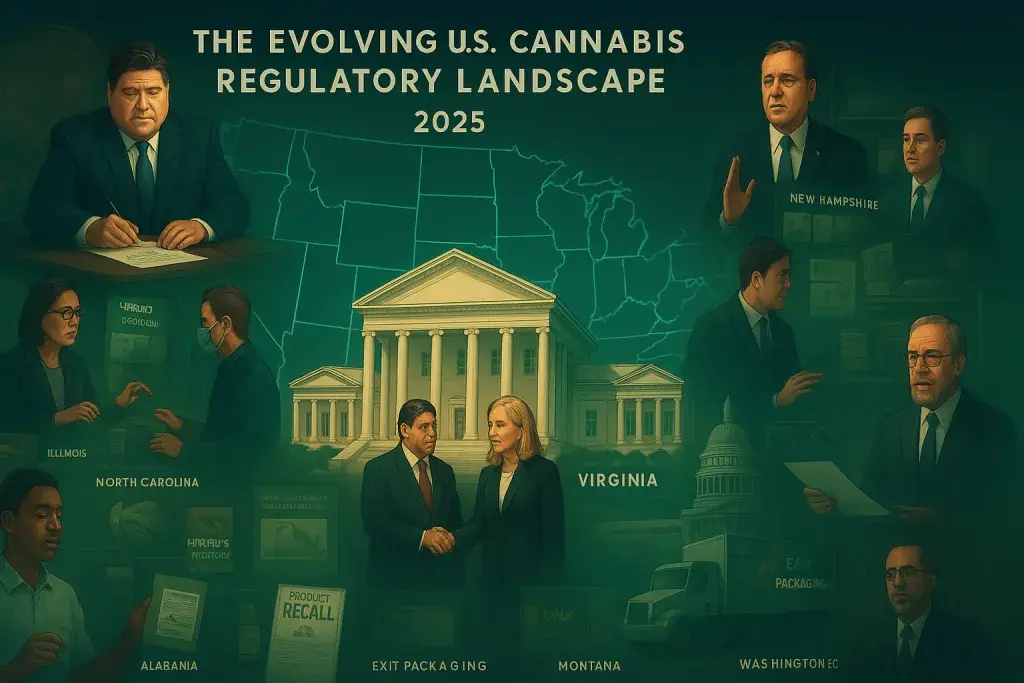
Virginia is on the verge of opening a regulated adult-use retail market - not through standalone legislation, but through the state budget, a mechanism that signals just how much political urgency now surrounds cannabis commerce in the Mid-Atlantic. Gov. Abigail Spanberger and legislative leaders have announced they have a deal to legalize recreational marijuana sales this month, though at least one state senator has already raised concerns about proposed criminal penalties included in the bill, a sign that even inside a broadly supportive caucus, the details can fracture quickly.
For licensed operators watching this from other states, the Virginia development is one piece of a much larger regulatory mosaic taking shape in 2025. Illinois Gov. JB Pritzker signed a comprehensive cannabis omnibus bill that doubles legal adult possession limits and tightens rules on hemp-derived THC products - a shift that will require dispensary compliance teams to revisit SKU management, intake procedures, and consumer-facing signage almost immediately. That kind of sudden operational recalibration is now routine in mature markets, which is precisely why dispensary technology infrastructure - including point-of-sale systems capable of handling rapid rule changes - has become a competitive priority. Operators in markets further west have already worked through several iterations of this, and solutions like marijuana pos software nevada reflect how purpose-built tools have evolved specifically to absorb compliance updates without requiring operators to rebuild workflows from scratch every time a governor signs something new.
The Illinois omnibus is worth examining more closely, because hemp THC restrictions are becoming a flash point in multiple states simultaneously. North Carolina's House Agriculture and Environment Committee approved a bill restricting hemp and kratom products to adults 21 and over. New Hampshire's governor vetoed a bill that would have allowed medical cannabis cultivators to use greenhouses - a reform specifically aimed at increasing supply and reducing patient costs. These aren't unrelated events. Regulators across the country are actively drawing tighter lines between licensed cannabis retail and the unregulated or minimally regulated hemp market, and every operator selling any hemp-derived product needs to treat that as a compliance exposure, not a peripheral concern.
Scheduling, Federal Posture, and What Rescheduling Actually Changes
Rep. Steve Cohen introduced legislation that would fundamentally alter how the federal government evaluates drug scheduling - including a mechanism that would effectively allow states to trigger federal reclassification by changing their own laws. Separately, the Marijuana Policy Project published analysis arguing that interstate commerce between licensed businesses would be "presumably federally legal" under the Trump administration's cannabis rescheduling framework. That's a claim operators should read carefully rather than act on immediately.
Here's the catch: "presumably federally legal" is not the same as legally cleared. Until federal courts validate interstate cannabis commerce in the context of any new scheduling rule, licensed wholesalers, multi-state operators, and brand suppliers who begin treating state lines as porous are taking on legal risk that their compliance counsel almost certainly hasn't blessed. The American Trucking Associations, testifying before the Senate, made the point plainly - rescheduling complicates zero-tolerance drug testing policies in safety-sensitive industries, and the ripple effects extend well beyond the cannabis sector. Any licensed cannabis business with a fleet, a delivery operation, or commercial contracts touching federally regulated transportation needs to think about that exposure now.
State-Level Activity Operators Can't Afford to Miss
Alabama recorded more than 100 patient purchases in the first week of legal medical cannabis sales - a modest number, but one that marks a genuinely significant milestone for a Deep South state that resisted legalization for years. Pennsylvania's Senate minority leader publicly framed the state's medical program as a foundation for adult-use expansion. Kansas Democratic gubernatorial candidates debated medical cannabis access. These aren't just political data points; they are indicators of where wholesale demand is heading and which markets are likely to require licensing, compliance, and retail infrastructure buildout within the next few years.
Ohio's Supreme Court is considering conflicting cases on whether the smell of cannabis alone gives police probable cause to search a vehicle - a question that has direct implications for licensed delivery drivers operating in that state. California regulators issued a product recall tied to incomplete and incorrect compliance testing, a reminder that laboratory COA integrity is not a back-office technicality. It is front-line liability. Montana sent updated guidance on exit packaging requirements. Washington, D.C. regulators moved to deny a retail license application over alleged illegal operation involvement. And Sacramento is preparing to vote on revised cannabis business zoning rules. Across all of this activity, the pattern is consistent: compliance is getting more granular, not less, regardless of political party or geographic region.
The Broader Regulatory Trajectory Isn't Slowing Down
Sen. Dick Durbin used Senate floor time to criticize mandatory minimums tied to the War on Drugs era, calling them ineffective and fiscally wasteful. Ukraine launched its first medical cannabis dispensations to veterans and a multiple sclerosis patient. Massachusetts' Supreme Judicial Court upheld the validity of a ballot measure that could roll back legalization. These developments span criminal justice reform, international market development, and direct democracy - all operating at the same time.
What does this mean for licensed cannabis businesses in the United States? To put it plainly: the regulatory environment is not stabilizing. It is diversifying. Operators who built their compliance infrastructure around one state's rules and one stable reading of federal law are the ones most exposed when Virginia adds a new adult-use market, Illinois rewrites possession and hemp rules simultaneously, and federal scheduling policy shifts underneath all of it. The businesses that absorb these changes without operational disruption are the ones that invested early in systems - tracking, POS, inventory, reporting - designed to flex with rule changes rather than fight them.
Trulieve's president resigned. Illinois dispensaries moved $13.8 million in medical cannabis products in a single month. These aren't footnotes - they are signals about the pace and pressure of this market. The operators still standing in five years will be the ones who treated compliance infrastructure as core business infrastructure, not as overhead.