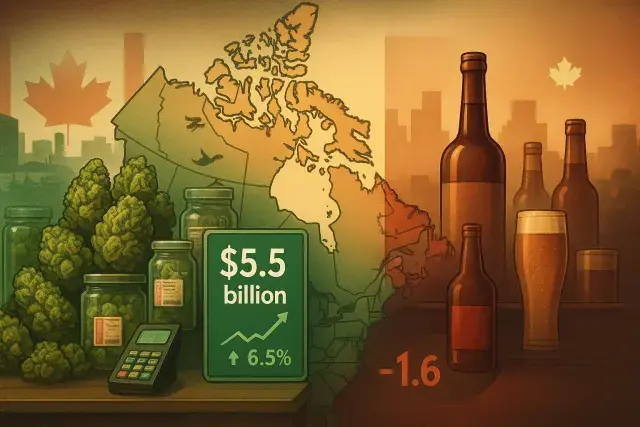
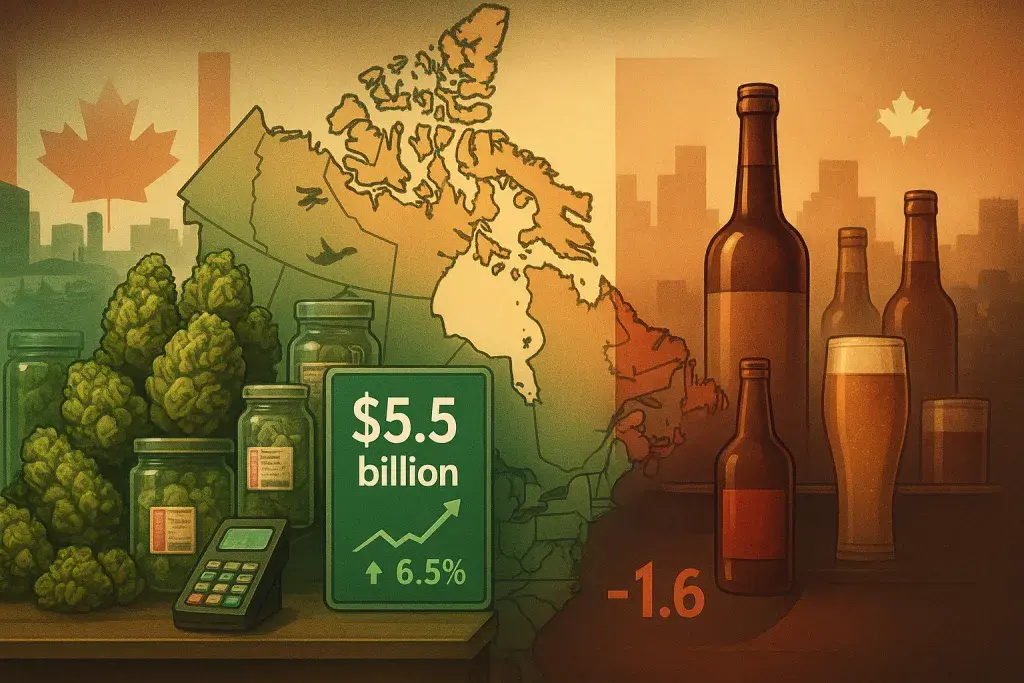
Canada's regulated cannabis market closed the fiscal year ending March 31, 2025, with $5.5 billion in adult-use sales - a 6.5 percent increase over the prior period - while alcohol revenue moved in the opposite direction, declining 1.6 percent over the same stretch. The data comes from Statistics Canada, the country's national statistical agency, and it adds hard numbers to a substitution pattern that operators on both sides of the border have been tracking for years. For cannabis retailers, the figures confirm that the market Canada built after federally legalizing adult-use in 2018 continues to mature and expand even as the novelty of legalization has long since worn off.
What's striking here is the consistency of the directional split. Herbal cannabis products - flower, by another name - still account for roughly 60 percent of all Canadian cannabis sales, which tells you a lot about where consumer demand is anchored even seven years into a legal market. Inhalable formats dominate SKU mix in mature regulated markets; that's not surprising. But the sustained growth rate suggests the legal channel is still absorbing consumers who may have previously relied on unregulated supply, which is a structural retail story as much as a consumer behavior story. In the United States, operators using a pos system for dispensary maryland and other state-specific retail environments have watched similar dynamics play out as compliant sales infrastructure matures and builds consumer trust over time - reinforcing that retail execution, not just legalization alone, drives long-term market growth. pos system for dispensary maryland
The alcohol comparison deserves more than a passing mention. Survey data published in 2024 in The Harm Reduction Journal found that 60 percent of cannabis consumers reported using cannabis to reduce their alcohol intake. That's self-reported data, with all the limitations that implies, but it aligns with findings from several U.S. jurisdictions, including California, where researchers have identified a relationship between expanded legal cannabis access and declining alcohol consumption. The mechanism isn't a mystery: adult consumers make substitution decisions across legal product categories all the time. The policy question - and the retail business question - is how durable that shift is, and whether it reflects a generational change in consumption preferences or a more cyclical pattern.
What the Numbers Mean for Operators
A 6.5 percent revenue increase in a market that has been legal for seven years is not trivial. Early-stage cannabis markets often post dramatic growth rates simply because the baseline is near zero; sustaining meaningful growth this far into maturity indicates that the retail infrastructure is working. Canada's provincially regulated distribution model - where operators must navigate province-by-province compliance requirements, excise tax obligations, and packaging rules - has historically added cost and friction to the supply chain. The fact that sales are growing despite that overhead is a signal worth noting.
For dispensary operators, the more operationally relevant implication is inventory and SKU management. A market where flower commands 60 percent of sales volume is a market that rewards tight purchasing discipline, strong relationships with licensed producers, and point-of-sale systems that can track category-level sell-through in real time. Operators who fail to manage that mix - overstocking slower-moving formats like edibles or beverages at the expense of high-velocity flower SKUs - absorb the margin hit directly.
The Regulatory and Compliance Context
Canada's adult-use framework sits under federal oversight through Health Canada, with provinces and territories managing retail licensing, store density, and in some cases direct distribution. That layered structure has meant uneven market development: some provinces moved quickly to license private retail, others maintained government monopolies or hybrid models. The compliance burden on individual store operators varies accordingly - excise stamps, seed-to-sale tracking requirements, compliant packaging, potency labeling, and age-verification protocols all apply regardless of province, but operational execution depends heavily on local regulatory expectations.
The substitution trend between cannabis and alcohol also carries a compliance signal. If regulators and public health agencies begin treating cannabis and alcohol as directly competing product categories rather than distinct verticals, the regulatory scrutiny on cannabis advertising, placement, and retail practices could intensify. Alcohol-sector rules in Canada are already among the more restrictive in the world. Cannabis operators should pay attention to how that regulatory logic might migrate.
A Market Still Finding Its Ceiling
Seven years in, Canada remains one of the few countries where a national cannabis market produces data clean enough to draw real conclusions. The $5.5 billion figure is meaningful precisely because it comes from a regulated, tracked system - not survey estimates or illicit market projections. That's what a mature, compliant retail infrastructure produces: numbers you can actually use.
The divergence from alcohol is real. Whether it holds depends on pricing discipline in the cannabis channel, continued consumer trust in legal product quality, and how regulators on both sides manage a market transition that no one fully planned for. The trend line is clear. What operators do with it is the actual business question.
Do not use marijuana if you are under 21 years of age or pregnant. Keep marijuana out of reach of children.