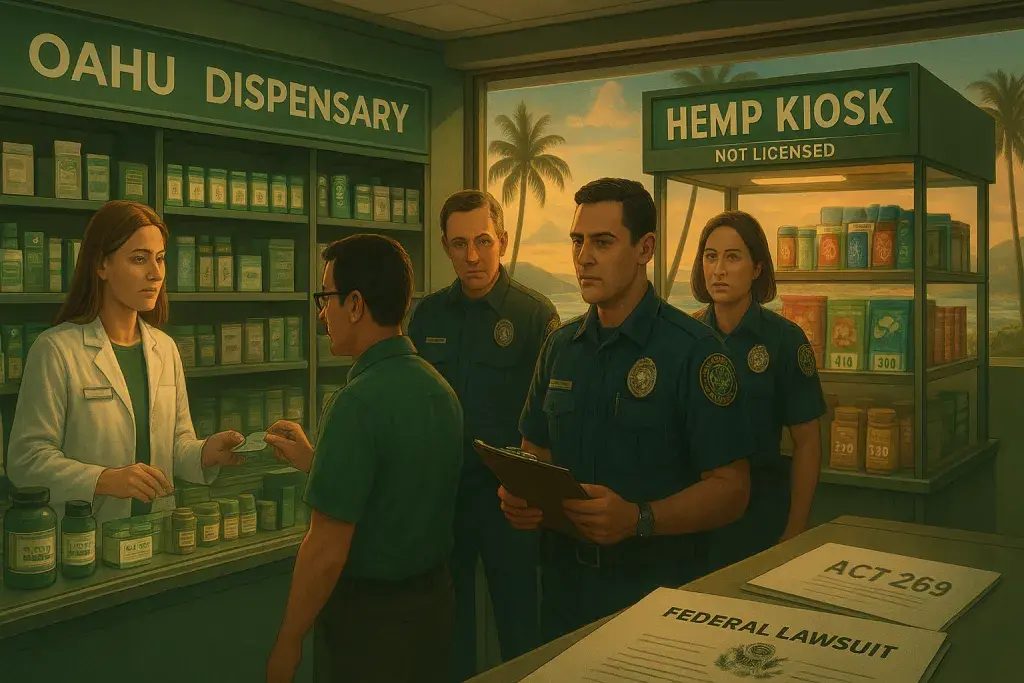
Hawaiʻi's Department of Health has moved to shut down sales of hemp-derived THC gummies, pre-rolled smokes and drinks that had quietly become a parallel cannabis market on Oʻahu and beyond. Retailers like Oʻahu Dispensary and Provisions, which sold the products without requiring a medical marijuana card, have pulled them from shelves under a new state enforcement push. The result is a federal lawsuit, a lobbying paper trail, and a fight over who gets to sell intoxicating cannabinoids in a state that never legalized adult-use marijuana.
The mechanics here matter for anyone watching regulated cannabis retail nationally. Hawaiʻi's licensed medical dispensaries operate under a tightly capped system - eight licensees, strict seed-to-sale tracking, lab testing requirements, compliant packaging rules - the whole apparatus states typically build around cannabis once they decide to regulate it. Hemp retailers selling delta-9 products derived under the 2018 Farm Bill's 0.3% THC threshold operated outside that system entirely, with no equivalent testing mandate, no dispensary license, and often lower price points. That price gap is not incidental; it's the whole story. Retail margins in regulated cannabis are already squeezed by 280E tax treatment and excise costs, and any operator watching an unregulated competitor undercut wholesale pricing while skipping compliance overhead is going to notice fast - the same way a well-run shop tracking every SKU through a cannabis POS for Rhode Island dispensaries would notice if a corner store down the street started selling the same product tax-free. cannabis POS for Rhode Island dispensaries
What makes Hawaiʻi's version of this fight distinct is how directly the licensed dispensary industry shaped the response. Internal correspondence shows a dispensary executive lobbying lawmakers directly, citing Department of Health market estimates that unlicensed retailers were capturing the bulk of cannabis spending statewide. That lobbying produced Act 269, which gave regulators registration and inspection authority over any retailer selling cannabinoid products - authority they previously lacked over hemp shops operating outside the medical program.
Enforcement Power Versus Market Reality
For compliance professionals, the operational takeaway is straightforward: registration-and-inspection regimes like Hawaiʻi's give regulators a tool to identify sellers, catalog inventory, and flag non-compliant batches without needing a full licensing overhaul. That's a lighter-weight enforcement model than standing up new license categories, and it's worth watching whether other states facing hemp-derived THC saturation adopt something similar rather than legislating adult-use markets outright. But it also concentrates enforcement discretion in an agency that, by its own account, is now drawing lines between what counts as an allowable hemp product and what gets pulled from a kiosk shelf - decisions retailers say arrive with little warning and real financial consequences for staffing and inventory planning.
A Medical Program Losing Registered Patients
The deeper pressure on Hawaiʻi's dispensary model is enrollment decline. State data shows the number of registered medical marijuana cardholders has dropped meaningfully over recent years, even as unlicensed retail locations multiplied. That's a familiar pattern in medical-only markets nationally: once cheaper, more convenient alternatives appear - even unregulated ones - patients drift away from card renewal, which erodes the revenue base dispensaries need to justify compliance costs, testing budgets, and lab partnerships. Whether closing the hemp loophole actually pushes consumers back into the regulated medical channel, or simply pushes the market underground, remains an open question regulators will have to track through sales data, not assumptions.
A Federal Fix With State-Level Fallout
Congress's move to redefine hemp at the federal level - set to take effect in December - may eventually settle Hawaiʻi's legal dispute by closing the loophole nationwide rather than through litigation. But that federal timeline doesn't resolve the underlying tension for operators: licensed dispensaries built around limited license caps and rigorous testing standards are still competing against a hemp-derived beverage and edibles market that scaled into the billions before most states figured out how to regulate it. For multistate operators, landlords leasing to cannabis retail, and payment processors serving the space, Hawaiʻi's fight is a preview of the compliance and enforcement questions still unresolved almost everywhere else.