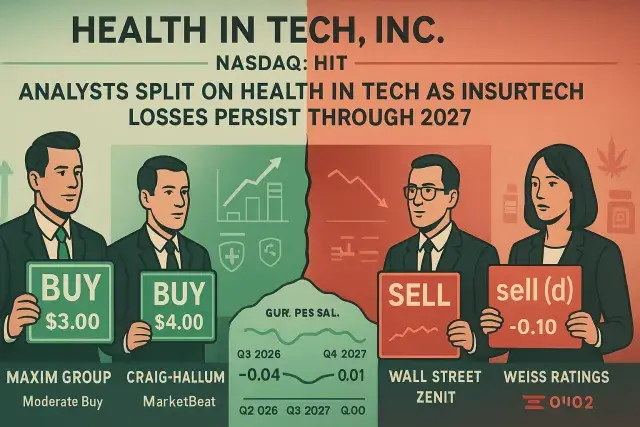
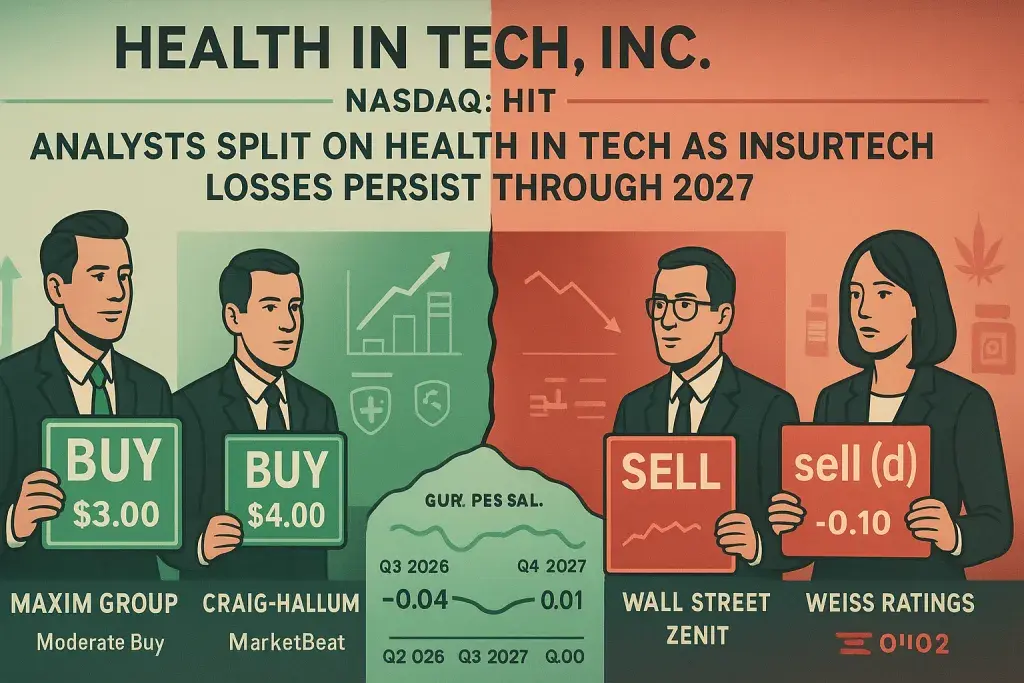
Health In Tech, Inc. (NASDAQ: HIT), a technology platform serving the health insurance distribution and benefits administration space, is drawing a mixed but attentive read from Wall Street as it works toward profitability. Maxim Group issued fresh estimates on Friday, August 14th, projecting a per-share loss of $0.04 for the third quarter of 2026, with continued red ink expected through most of the forecast window into 2027. The firm maintained a "Buy" rating and a $3.00 price target, betting that the company's underlying model has more runway than the near-term losses suggest.
For operators and vendors adjacent to regulated markets, watching how a health-tech platform manages a multi-year path to breakeven is instructive, even outside cannabis retail proper. Payment infrastructure, point-of-sale integration, and compliance-driven software are all capital-intensive categories where early-stage public companies post losses while building out distribution. That dynamic isn't unique to insurtech; it echoes what dispensary technology vendors experience when scaling seed-to-sale integrations or, for that matter, when a company builds out something like cbd point of sale oregon infrastructure to serve a fragmented, state-by-state regulatory map. The lesson for B2B buyers evaluating any platform vendor, health-tech or cannabis-tech, is the same: a "Buy" rating on a loss-making stock reflects a bet on scale, not current earnings.
Maxim's numbers lay out a gradual climb. The firm models a $0.03 loss per share for Q4 2026, bringing full-year 2026 losses to $0.10 per share. Things improve modestly from there - a projected $0.01 per share of positive earnings in Q1 2027, a small step back to a $0.01 loss in Q2, breakeven in Q3, and a $0.02 loss in Q4, netting out to a $0.02 per-share loss for full-year 2027. That's not a smooth glide path to profitability; it's a bumpy one, with quarters of modest gains offset by quarters of renewed losses. Investors reading this timeline should understand it as a forecast, not a guarantee - estimates from a single analyst, however credentialed, are not financial certainty.
A Divided Analyst Field
The disagreement among research houses is notable. Wall Street Zen downgraded the stock from "hold" to "sell" back in late April, a sharply different read than Craig Hallum's initiation of coverage days earlier with a "Buy" rating and a $4.00 price target. Weiss Ratings, meanwhile, restated a "sell (d)" rating in late June - a grade that signals real skepticism about the company's near-term fundamentals. Put those three views side by side and you get a textbook case of analyst disagreement: one shop sees a growth story worth a premium price target, another sees a stock that's overvalued relative to its earnings trajectory, and a third assigns a grade that suggests deeper concern about balance-sheet health or business quality.
Aggregated data from MarketBeat.com puts the consensus at "Moderate Buy," with an average price target of $3.50 - a figure that splits the difference between the more bullish and more cautious camps. One analyst has issued a Strong Buy, one a Buy, and one a Sell. That's a thin sample, and it's worth saying plainly: three ratings do not make a robust consensus. Anyone using this stock as a proxy for sector sentiment, in health-tech or in any adjacent regulated-technology space, should treat the spread itself as the headline, not the average.
What This Means for Technology Vendors Watching From the Sidelines
Why should anyone in regulated retail - cannabis, health benefits, or otherwise - care about one small-cap insurtech's earnings estimates? Because the pattern here is common to any company selling software and distribution services into a fragmented, compliance-heavy market. Losses compound while a platform builds out integrations, sales teams, and regulatory relationships across jurisdictions; profitability arrives, if it arrives, only after that infrastructure is largely built. Compliance-facing technology vendors serving dispensaries, from point-of-sale providers to inventory and compliance-log software, follow a similar arc. The takeaway for operators evaluating any vendor's financial stability isn't to avoid companies posting losses - it's to understand what stage of that build-out they're in, and whether the analyst consensus reflects genuine conviction or a handful of divergent bets.