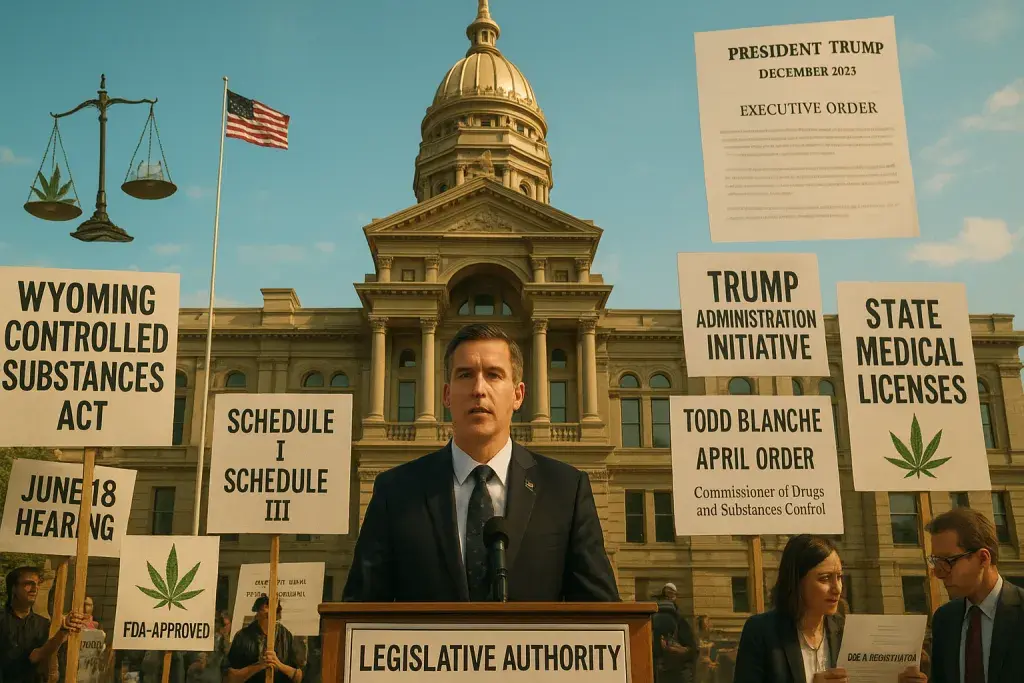
Wyoming's Attorney General has formally objected to a federal rescheduling action that would move marijuana from Schedule I to Schedule III of the Controlled Substances Act - putting the state in direct tension with a Trump administration initiative designed to expand medical cannabis research and access. The objection, filed under Wyoming statute, argues that removing marijuana from Schedule I is a decision that belongs to the state legislature, not to an administrative rulemaking process. A hearing on the objection is scheduled for June 18 at the Wyoming State Capitol.
The federal action at issue stems from an order signed by Acting Attorney General Todd Blanche in April, which moves cannabis products approved by the FDA or covered under state medical cannabis licenses from Schedule I to Schedule III. The move is framed as consistent with a December 2025 executive order from President Trump on expanding medical marijuana and cannabidiol research - and Schedule III classification does carry meaningful implications, since substances in that category are recognized as having accepted medical uses and a moderate to low potential for dependence. For compliance professionals and operators tracking how rescheduling might affect everything from testing protocols to point-of-sale documentation, state-level divergence from federal action is exactly the kind of friction that complicates planning. Operators in states with mature regulatory frameworks - where tools like dispensary pos software california help manage compliance workflows - understand how quickly a shift in scheduling status can ripple through licensing, inventory, and reporting systems.
Wyoming's objection rests on a specific statutory mechanism: state law requires the Commissioner of Drugs and Substances Control to align with federal scheduling changes within 30 days of notice in the Federal Register, but it also allows the commissioner to formally object within that same window. Wyoming exercised that option. The objection's core argument is straightforward - the Wyoming Legislature has never legalized medical marijuana, has never established a licensed medical cannabis regulatory scheme, and has not approved recognition of other states' medical cannabis licenses. Moving marijuana covered by a state medical license to Schedule III, the objection states, is therefore inconsistent with the police powers the legislature has actually exercised. "The question of whether to remove any type of marijuana from Schedule I of the Wyoming Controlled Substances Act is for the Wyoming Legislature and should not be done through the administrative rule making process," the filing states directly.
What the Rescheduling Action Actually Does - and Doesn't Do
Here's worth being precise about what rescheduling means in practice. Moving marijuana to Schedule III does not legalize it at the federal level. It does not override state prohibition. What it does is change the regulatory and research framework - Schedule III substances can be studied more freely, prescribed under certain conditions, and are not subject to the same blanket restrictions as Schedule I drugs. The DOJ has also announced procedural updates to expedite the broader rulemaking process to complete the transition. A separate hearing on that rulemaking is set for June 29 in Arlington, Virginia.
The Wyoming objection also makes a narrower technical point: FDA-approved marijuana products already sit in scheduling consistent with federal rules. The objection here is specifically to extending Schedule III status to marijuana covered by state medical licenses - something Wyoming doesn't have. That distinction matters. Wyoming isn't arguing against federal rescheduling of FDA-approved pharmaceutical cannabinoids; it's arguing against importing another state's medical licensing framework into Wyoming's own controlled substances schedule through an administrative back door.
Why State-Level Divergence Matters for the Regulated Industry
For multi-state operators, investors, and compliance teams watching this situation, Wyoming's objection illustrates a durable structural problem in U.S. cannabis regulation: federal and state scheduling don't move in lockstep, and when they diverge, the compliance burden falls on licensed businesses. Even a well-intentioned federal rescheduling effort can generate patchwork outcomes across states - some automatically conforming, others filing objections, others waiting on their own legislative processes.
Operators and their counsel need to track this carefully. Scheduling status affects more than just legal exposure. It touches research access, banking relationships, DEA registration requirements, and - potentially - how state regulators in conforming states update their own compliance and reporting rules. States that automatically align with federal scheduling changes may see operational shifts well before states like Wyoming, where the legislature holds the reins. That asymmetry doesn't resolve itself quickly.
The Wyoming hearing on June 18 will be an early indication of how the state's administrative process handles the objection. Comments can be submitted to [email protected]. The federal rulemaking hearing on June 29 runs in parallel - and what emerges from Arlington will shape the national framework that states will then have to respond to, one by one.