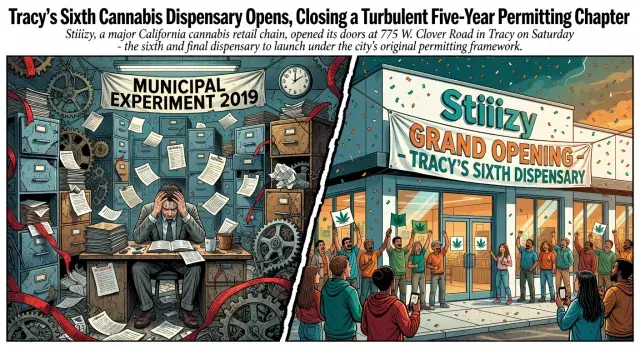
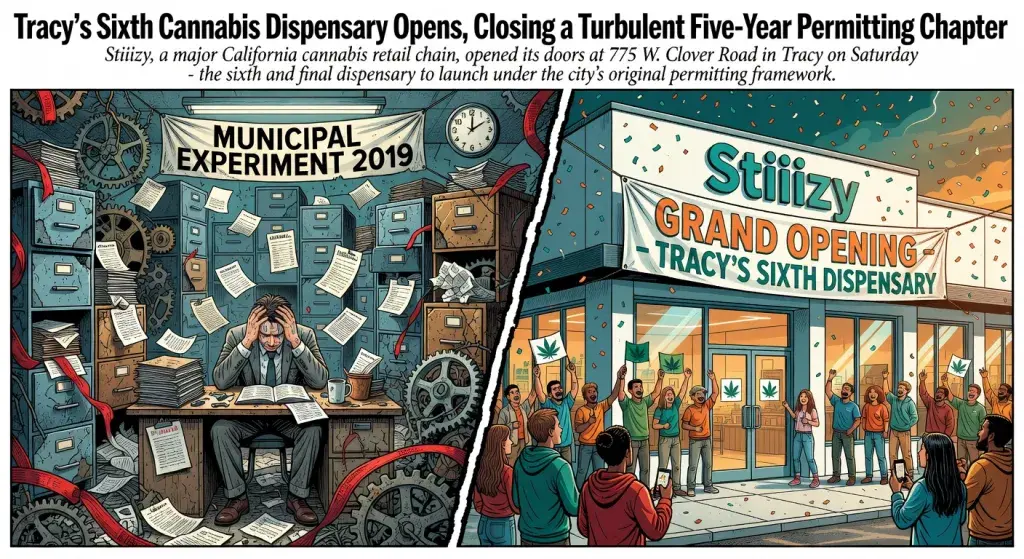
Stiiizy, a major California cannabis retail chain, opened its doors at 775 W. Clover Road in Tracy on Saturday - the sixth and final dispensary to launch under the city's original permitting framework. What began in 2019 as an ambitious municipal experiment with as many as 12 dispensaries in the pipeline has, after half a decade of regulatory revisions, public hearings, and bureaucratic delay, landed on a round six.
A Long Road from Application to Grand Opening
The timeline here tells its own story. Authentic Tracy LLC, the entity behind the Stiiizy location, first applied for cannabis retail permits in 2020. The city didn't grant the permit until March 2022 - and only after revising its rules to raise the cap on retail storefronts from four to eleven. One of those approved slots was designated for delivery only.
Even after the permit came through, the process crawled. The Tracy Planning Commission approved the conditional use permit for the Clover Road site in June 2023, then extended it in April 2024. The building permit followed the next month. From initial application to soft opening on September 27 of this year: roughly four and a half years. That's not unusual for cannabis retail in California, where local permitting layers stack on top of state licensing requirements, but it's still a striking duration for a single storefront.
Soft Launch, Big Turnout
Chad Espinoza, Stiiizy's New Store Opening Director, said the Tracy location - the chain's 48th dispensary - spent two weeks after its soft opening training a staff of about 15 employees. Customers found the shop anyway. By Saturday morning, the line wrapped around the building. Free promotional gifts didn't hurt.
"A lot of people know our product selection, and then we're really big on word of mouth," Espinoza said, describing a marketing strategy that leans on email outreach, social media, listing platforms like Weedmaps, and referrals from the company's other locations. The approach is notably low-key for a chain of that size - less billboard blitz, more organic community engagement. Fair enough: cannabis advertising remains constrained by a patchwork of state and local rules that make traditional marketing channels difficult to access.
New Rules, Tighter Buffers
Here's the catch. Stiiizy's opening effectively draws a line under Tracy's first-generation cannabis retail policy. By late 2023, the city had already begun moving toward stricter regulations, including wider buffer zones between dispensaries and youth-oriented businesses or residential areas. Any future applicants will face a more restrictive landscape - larger mandated distances from schools, parks, and homes.
That shift reflects a pattern playing out across California's smaller cities. The initial wave of legalization-era permitting was often expansive, driven partly by revenue projections and partly by a desire to bring cannabis sales out of the gray market. Then came the pushback: neighborhood complaints, zoning conflicts, and the political reality that twelve dispensaries in a city of roughly 93,000 people struck many residents as too many. Tracy's whittling - from twelve potential shops to six actual ones - mirrors the recalibration happening in municipalities statewide.
The stricter rules won't apply retroactively to existing dispensaries. But they signal that Tracy's municipal appetite for cannabis retail has, at minimum, plateaued. For Stiiizy, the timing was fortunate. Slide the approval process back by another year or two, and the Clover Road location might never have materialized under the new framework.
What Six Dispensaries Mean for Tracy
Six licensed cannabis retailers in a mid-sized San Joaquin Valley city is neither extravagant nor negligible. Each storefront generates local tax revenue through the cannabis business tax that California municipalities are permitted to levy on top of state excise taxes. Each also creates a modest number of jobs - Stiiizy's 15-person staff is typical for the industry.
The broader question is whether the market can sustain all six. California's legal cannabis sector has been under severe pressure for years, squeezed between high tax burdens, persistent illicit market competition, and declining wholesale prices. Dispensaries in smaller cities are particularly vulnerable. Some of Tracy's original twelve applicants dropped out for reasons that likely included exactly this calculus - the margins just didn't pencil out.
For now, though, the sixth shop is open. The line has been cut. And Tracy's long, winding experiment in cannabis retail permitting has, at last, reached something resembling its final form.