TerrAscend Corp. is making two significant moves at once: locking in an option to acquire a fifth dispensary in New Jersey and pushing shareholders to approve a share consolidation that would position the company for an uplisting to a major U.S. stock exchange. The dual announcements signal a company working both ends of the growth equation - expanding its retail footprint in one of the country's more active adult-use markets while cleaning up its capital structure to attract institutional investors.
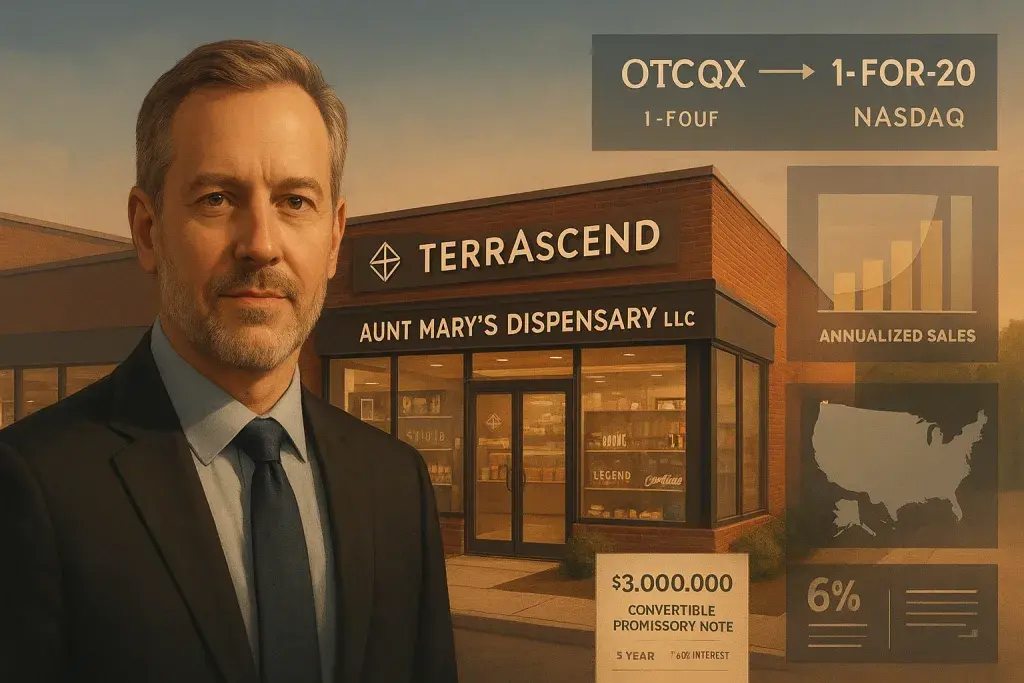
The target acquisition is Aunt Mary's Dispensary LLC, a 5,200-square-foot operation in Flemington, Hunterdon County, that opened in February 2023 and reportedly generates more than $10 million in annualized revenue. The deal is structured as an option agreement: TerrAscend pays $3 million via a five-year unsecured convertible promissory note at 6% interest to secure the right to acquire a 35% stake, with another $6 million in cash due if the option is exercised, for a total purchase price of $9 million. That structure keeps TerrAscend's near-term cash outlay manageable while reserving the right to close. For multi-state operators (MSOs) managing liquidity carefully in a high-tax, capital-constrained environment, option agreements like this are a practical tool - they let the acquiring company perform deeper diligence without fully committing capital before regulatory approval is in hand. The approach mirrors how operators running dispensary software in Ohio and other competitive adult-use states are rethinking deal timelines, building optionality into acquisition structures rather than locking up cash ahead of an uncertain regulatory clock.
What makes Aunt Mary's attractive isn't just the revenue number - it's the margin story TerrAscend is telling around vertical integration. Executive Chairman Jason Wild pointed specifically to the company's brand portfolio - Kind Tree, Legend, Valhalla and Cookies - as margin drivers that could be introduced to Aunt Mary's shelves post-acquisition. That's a familiar MSO playbook: bring a standalone dispensary into your vertical ecosystem, replace some third-party wholesale SKUs with house brands, capture more of the value chain, and expand EBITDA without meaningfully growing overhead. In New Jersey's recreational market, where competition for shelf space and consumer wallet share has intensified since adult-use sales launched, vertical integration can be a genuine differentiator for operators who have the production capacity to support it.
The Capital Structure Question That's Been Hanging Over MSOs
The shareholder vote TerrAscend filed a preliminary proxy for - scheduled for August 24, with a record date of June 30 and a proxy deadline of 1 p.m. Eastern on August 20 - is about one thing: share price. To meet minimum listing requirements on a major U.S. exchange, TerrAscend needs its share price to clear a threshold that its current per-share price apparently doesn't. A reverse share consolidation is the standard mechanism, and TerrAscend's board is asking shareholders to approve a ratio anywhere between 1-for-5 and 1-for-20, with the exact ratio and timing left to board discretion within 12 months of approval. That range is deliberately wide. It gives the board flexibility to calibrate against market conditions - a tighter ratio if the stock recovers, a steeper one if it doesn't.
TerrAscend already checks several of the boxes major exchanges look for: its financials are prepared under U.S. GAAP, its shares are SEC-registered, and it trades on the OTCQX. The missing piece is share price. The company's statement that uplisting is "no longer a question of if, it is a question of when" is a bold framing - but it does reflect a real shift in how the cannabis industry is reading the regulatory environment. The broader expectation that federal scheduling changes or SAFE Banking-adjacent legislation could eventually clear the path for cannabis companies to list on the NYSE or Nasdaq has been building for some time. TerrAscend is positioning itself to move quickly when that window opens, rather than scrambling to meet requirements after the fact.
What This Means for Operators Watching From the Sidelines
For dispensary operators and cannabis investors, the TerrAscend announcement is worth reading on two levels. First, the Aunt Mary's deal illustrates how strong-performing independent dispensaries in limited-license markets continue to attract acquisition interest from larger operators. A dispensary doing more than $10 million in annualized revenue from a single 5,200-square-foot location in a high-traffic corridor with limited nearby competition is exactly the kind of asset MSOs are looking for - predictable revenue, manageable footprint, clear upside through branding and inventory optimization. Independent operators in states like New Jersey, where license counts remain controlled, should understand that their assets may carry more value than their current revenue alone suggests.
Second, the share consolidation mechanics are a window into the structural awkwardness that has defined cannabis capital markets since the beginning. MSOs have largely been locked out of major U.S. exchanges due to federal cannabis law, even when their underlying businesses generate real revenue and operate under robust state compliance frameworks. The ability to list on a major exchange would meaningfully expand the investor base available to cannabis companies - institutional funds constrained by mandate from holding OTC securities could potentially participate, and research analyst coverage typically increases with exchange-listed status. That's not a minor operational footnote; it affects cost of capital, acquisition currency, and long-term competitive positioning.
TerrAscend's footprint - Pennsylvania, New Jersey, Maryland, Ohio, California, and retail operations in Canada - gives it scale, but scale in cannabis retail doesn't automatically mean efficiency. The company's ability to execute on the Aunt Mary's margin thesis, while simultaneously managing a multi-jurisdictional compliance burden across meaningfully different regulatory regimes, will be the real test of the strategy behind both announcements.