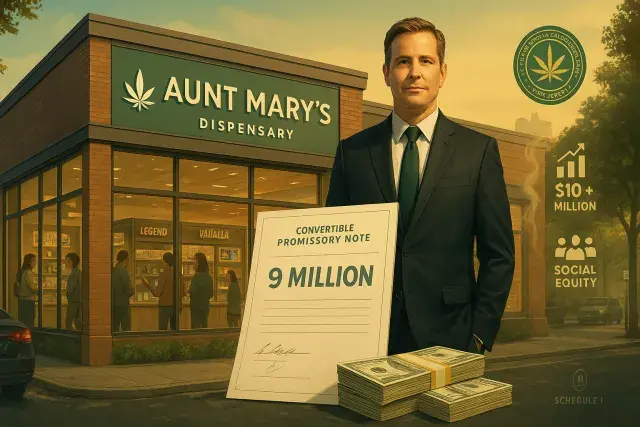
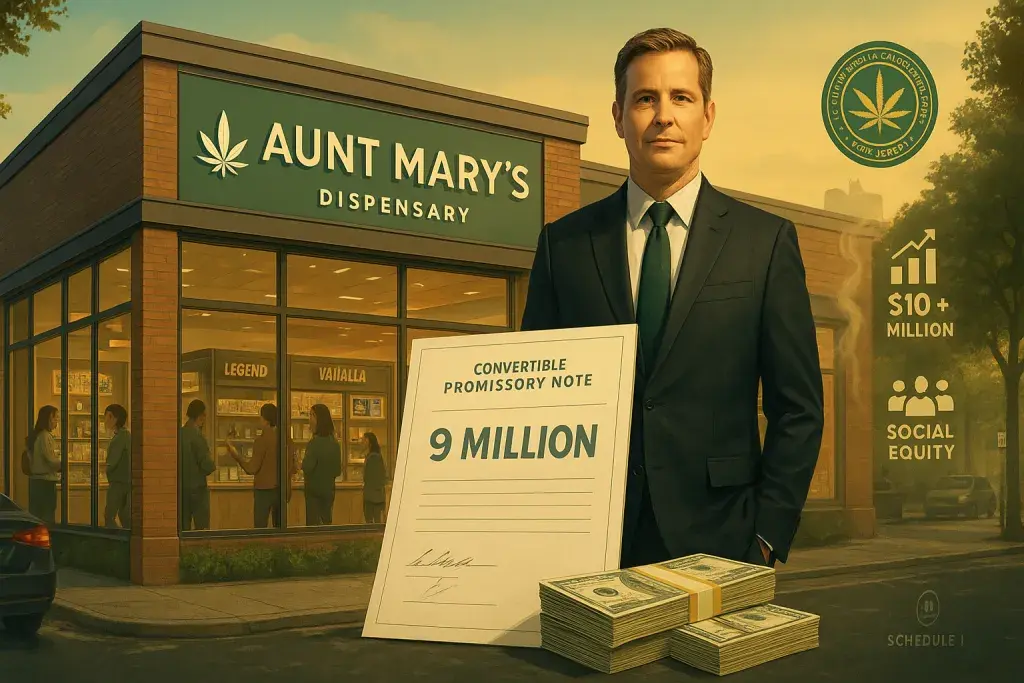
TerrAscend Corp. has signed an agreement to acquire Aunt Mary's Dispensary in Flemington, New Jersey - a move that would give the Toronto Stock Exchange-listed multi-state operator its fifth dispensary in the state. The deal, structured through an option arrangement, is valued at $9 million and targets a location that the company says generates more than $10 million in annualized revenue. Regulatory approval is still required before the transaction closes.
The financial structure breaks down like this: TerrAscend will issue a $3 million unsecured convertible promissory note at 6% interest over five years, which grants an option to acquire a 35% stake in the business. If that option is exercised, the remaining $6 million is paid in cash. For operators watching how multi-state operators fund retail expansion in a capital-constrained environment, that structure - part debt instrument, part deferred equity - reflects the kind of creative deal-making that's become common in licensed cannabis markets where traditional financing remains difficult to access. Retail technology vendors and operators in other regulated states, from those using IndicaOnline dispensary software in Colorado to platform providers in the Northeast, have seen similar dynamics play out as larger operators prioritize acquisition over greenfield build-outs when regulatory caps and licensing timelines make organic expansion slow.
Aunt Mary's opened in February 2023 and occupies 5,200 square feet in what TerrAscend describes as a busy retail corridor in Flemington. For a dispensary that's been operating for roughly two years, crossing $10 million in annualized revenue is a meaningful performance benchmark - it suggests the location has established consistent foot traffic and a functioning customer base. TerrAscend Executive Chairman Jason Wild pointed directly to margin improvement as the rationale: "We see a clear opportunity to enhance margins through vertical integration and the introduction of our premium brand portfolio, including Kind Tree, Legend, Valhalla and Cookies." That's standard post-acquisition logic in cannabis retail - once a multi-state operator brings a standalone dispensary into its vertical structure, it can redirect wholesale spend toward its own cultivated and manufactured products, compressing cost of goods and widening margins without necessarily changing the retail experience on the floor.
Vertical Integration as the Operational Play
The vertical integration argument TerrAscend is making here isn't just financial positioning - it's operationally concrete. A dispensary generating $10 million in revenue is purchasing a meaningful volume of wholesale product from third-party brands and cultivators. When an operator with licensed cultivation and manufacturing brings that dispensary in-house, it can shift a portion of that wholesale spend to internal cost, replacing external margin bleed with inter-company transfers. The margin expansion opportunity is real, though it depends on production capacity, SKU alignment between the acquirer's brand portfolio and what local consumers actually buy, and whether the acquiring company can maintain the product variety that drove the location's performance in the first place.
TerrAscend's brand portfolio - Kind Tree, Legend, Valhalla Confections, Cookies, and others - is already established in New Jersey, which reduces the introduction risk. Cookies, in particular, carries strong brand recognition. The question any operator asks after an acquisition like this is whether the existing customer base at Aunt Mary's was drawn to that specific dispensary's curation, or whether they're largely indifferent to which brands stock the shelves. That distinction shapes how aggressively an acquirer can consolidate purchasing toward its own products without risking revenue.
The Regulatory Layer - Social Equity and Deal Structure
One detail in this transaction that shouldn't get lost: TerrAscend explicitly stated the deal was structured to comply with New Jersey cannabis regulations designed to support investment in diversely owned cannabis businesses. New Jersey's adult-use licensing framework includes provisions intended to ensure that larger operators don't simply crowd out independently and diversely owned licensees. The option-based structure - where TerrAscend acquires a minority stake first before having the right to take full ownership - appears to reflect that regulatory architecture. That's not a throwaway line in a press release; it signals that regulators will scrutinize how this transaction is constructed, not just whether it closes.
For other MSOs eyeing retail acquisitions in New Jersey, this deal serves as a working model for how to approach diversely owned licensee targets in a state where those ownership protections carry legal weight. Getting the structure wrong at the term sheet stage could mean a prolonged regulatory review or, worse, a denial.
Federal Risk Remains Part of Every Cannabis Balance Sheet
TerrAscend's disclosure around federal law deserves a plain read. The U.S. Department of Justice reclassified certain marijuana products as Schedule III substances in April 2026 - but only those approved by the FDA or licensed under a state medical program. Most marijuana products remain Schedule I under federal law. That gap matters. Businesses operating in adult-use markets, including New Jersey's, continue to face exposure under federal money-laundering statutes even when they're fully compliant at the state level. TerrAscend acknowledged that stricter federal enforcement could have a significant effect on its operations.
For any operator reading this - that's not boilerplate. That's a material risk disclosure from a publicly traded company with lawyers and accountants behind it. Banking access, payment processing, and interstate commerce remain constrained by the federal classification overhang. An acquisition that looks clean on the income statement can still carry structural vulnerability that no state license eliminates.
The Flemington deal is, at its core, a disciplined retail consolidation move: a performing asset, a definable integration path, and a structure built to satisfy state regulators. Whether it closes on that logic depends on how the New Jersey Cannabis Regulatory Commission reviews the transaction - and whether TerrAscend's fifth location in the state represents growth or market concentration in the eyes of the people holding the pen on that approval.