There is a moment in any licensed cannabis business when the founding team - the people who survived licensing, built the floor operations from scratch, and steered through early compliance chaos - stops being an asset and starts being a ceiling. Recognizing that moment, and acting on it, is one of the hardest decisions in regulated retail. Miss it, and the window closes quietly.
For multi-location operators and single-store independents alike, the operational structure that worked during the first two or three years of licensure rarely holds up under the weight of a mature market. Inventory management grows more complex. Wholesale pricing compresses. Consumer expectations shift. Tax obligations under Section 280E continue to punish profitability in ways that demand strategic financial restructuring, not just cost-cutting at the margins. Operators who got comfortable with the original setup - same point-of-sale configuration, same purchasing relationships, same floor staff hierarchy - often find themselves watching newer licensees eat into their customer base with better technology and tighter compliance workflows. That pressure is particularly sharp in competitive adult-use states; operators looking at point-of-sale for Nevada dispensaries, for example, are contending with a mature market where operational efficiency and compliance accuracy separate the businesses that scale from those that stall.
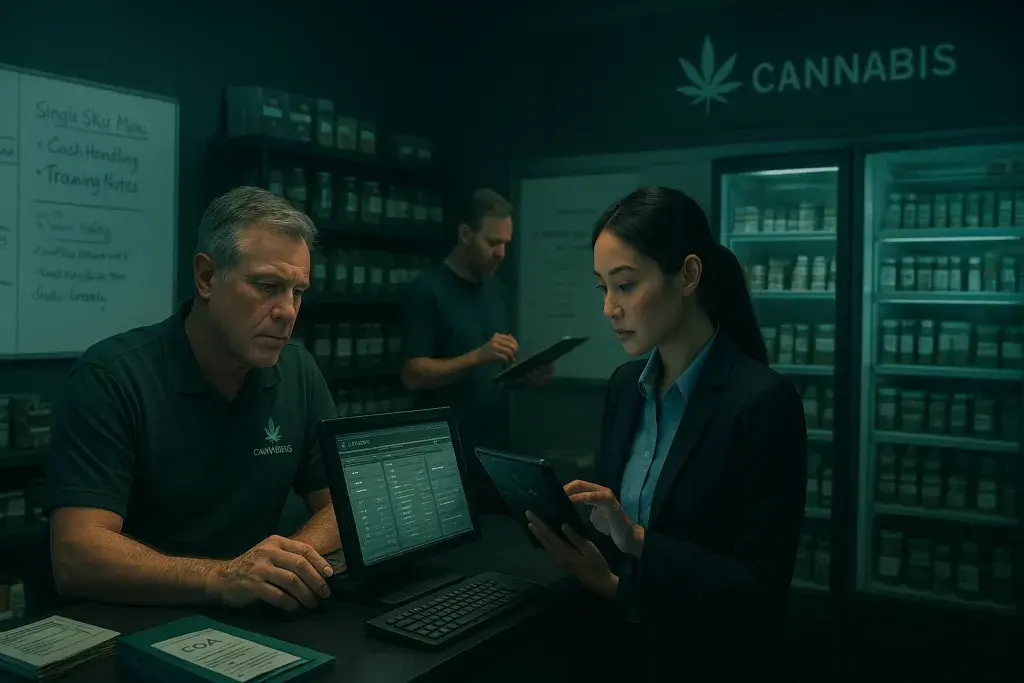
The instinct is to protect what built the business. That is understandable. Founding operators, long-tenured general managers, and legacy supplier relationships carry institutional knowledge that is genuinely hard to replace. But institutional knowledge calcifies when it is not challenged. A budtender workflow designed for a single SKU menu does not translate cleanly to a 400-product catalog with rotating limited drops and state-mandated batch-level traceability requirements. A compliance officer who thrived under version one of a state's seed-to-sale rules may struggle when regulators issue updated METRC reporting protocols or expand mandatory COA display requirements at the point of sale.
When Loyalty Becomes a Liability
There is nothing cynical about acknowledging that operational roles have lifecycles. A dispensary's general manager who excelled at launching the store - managing the initial licensing inspection, building vendor relationships, training the first wave of staff - may not be the right person to lead a second or third location buildout. The skill sets are different. Opening a store requires tolerance for ambiguity and a generalist's range. Running a scaled operation requires systems thinking, data fluency, and the ability to enforce compliance standards across a distributed team without being present for every transaction.
The same logic applies to supplier relationships. A cannabis brand that earned preferred-shelf placement during a market's early days - when product variety was limited and any compliant SKU was welcome - may be delivering declining sell-through rates in a market now flush with options. Wholesale buyers at well-run dispensaries review their inventory mix with the same discipline a retailer applies to shrinkage audits. Sentiment is not a metric. If a product is moving slowly, occupying valuable cooler space, or generating disproportionate compliance documentation relative to its revenue contribution, that is a data problem - not a loyalty test.
Here's the catch, though: moving on from people, brands, or systems without a clear replacement strategy creates a different kind of operational risk. A dispensary that parts ways with its compliance manager mid-cycle - before a scheduled regulatory inspection or a state license renewal - is trading one problem for a worse one. Timing matters. So does sequencing.
What a Meaningful Operational Overhaul Actually Requires
Real restructuring in a licensed cannabis operation is not a personnel announcement. It is a systems audit that touches purchasing, compliance, point-of-sale configuration, staff training protocols, and customer data management simultaneously. That sounds like a lot - and it is. The operators who do it well tend to approach it in phases rather than all at once.
- Inventory and purchasing review: Which SKUs are underperforming on velocity, margin, or compliance documentation burden? Which wholesale relationships are delivering consistent COA accuracy and on-time delivery manifests?
- Technology stack assessment: Is the current POS system generating the reporting depth needed for state compliance submissions? Does it integrate cleanly with the METRC or equivalent seed-to-sale platform the state requires?
- Staff capability mapping: Where are the gaps between what the operation needs at its current scale and what the existing team was hired to do?
- Financial structure review: How is the business managing 280E exposure? Is cash flow structured to absorb tax liabilities without disrupting payroll or purchasing cycles?
None of this is comfortable. But the alternative - preserving a structure that has stopped producing results because it once did - is a slow drain, not a sustainable strategy.
The Transparency Problem Operators Keep Underestimating
One pattern that shows up repeatedly in dispensary operations that struggle through transitions: a failure to communicate clearly with the people being affected by the change. A general manager who learns through rumor that the ownership group is considering a restructuring is far more likely to leave early, take institutional knowledge with them, or - in the worst cases - become a compliance liability through disengagement. The same applies to wholesale partners who suddenly find their products deprioritized without explanation.
Regulated retail is a small world. Relationships between operators, brands, distributors, and compliance consultants are dense and overlapping. The dispensary that handles transitions with directness and professionalism preserves its reputation in that network. The one that handles them badly does not get a second chance to make the same mistake quietly.
To put it plainly: the strongest cannabis operations are the ones that treat operational restructuring as a standard business function - not a crisis response, not a betrayal of founding culture, and not something to delay until the quarterly numbers force the conversation. Build for the operation you need next, not the one that got you here.