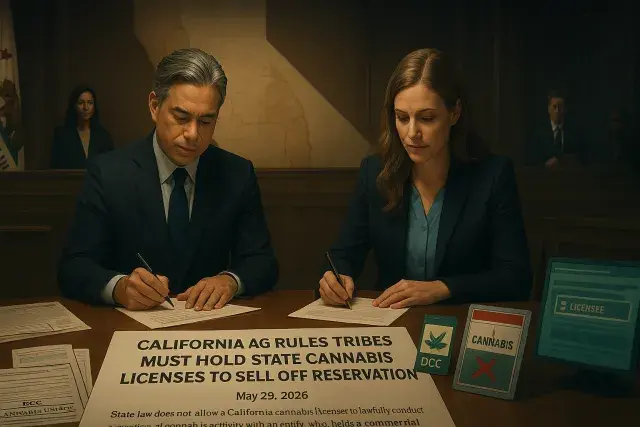
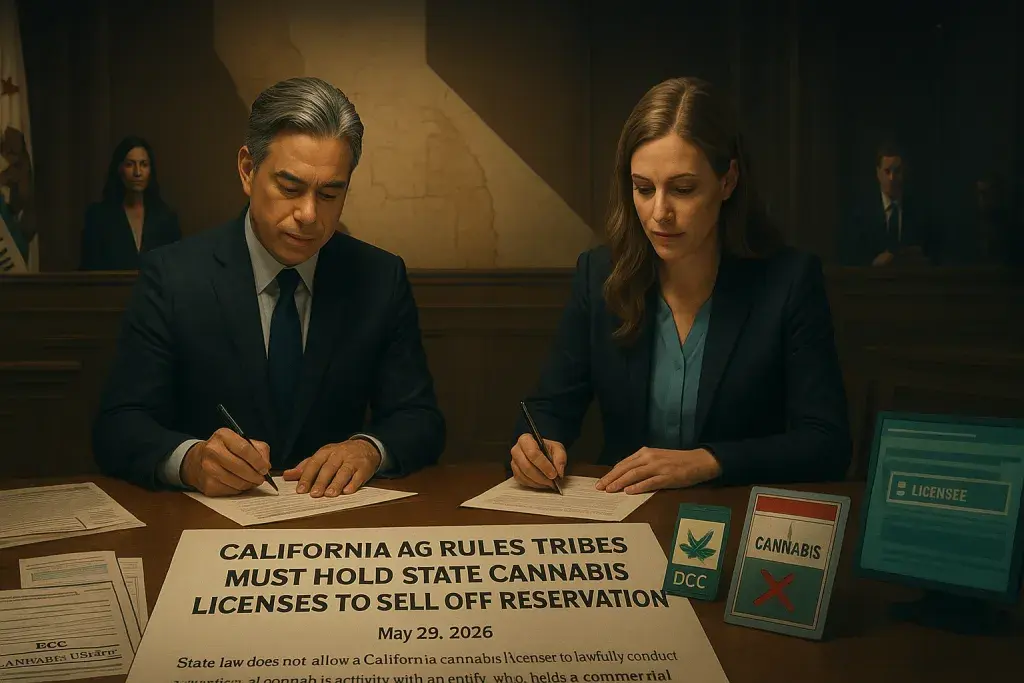
A formal opinion issued May 28, 2026, by California Attorney General Rob Bonta has settled a long-open compliance question with direct consequences for licensed dispensaries, distributors, and any cannabis operator currently doing business with tribally licensed entities: federally recognized tribes must obtain a commercial cannabis license from the California Department of Cannabis Control to engage in cannabis commerce with state licensees off tribal lands. No tribal licensing structure, however rigorous, substitutes for a state-issued license in off-reservation transactions.
What the Opinion Actually Says - and What It Doesn't
The opinion, authored jointly by Bonta and Deputy Attorney General Heather Thomas in response to a request from Assemblymember Anamarie Ávila Farías, applies the two-part test the U.S. Supreme Court established in Mescalero Apache Tribe v. Jones. To pass that test, state law must be nondiscriminatory and not prohibited by express federal law. California's licensing regime clears both bars. Every participant in the commercial cannabis market - wholesale distributor, manufacturer, retailer, delivery operator - must hold a DCC license. The obligation applies uniformly. And the opinion finds no federal statute or treaty that carves out an exemption for tribal entities conducting commercial cannabis activity beyond reservation borders.
What the opinion deliberately does not address is equally important. On-reservation cannabis activity raises more complex jurisdictional questions - including the civil-versus-criminal regulatory distinction required under Public Law 280 - and Bonta and Thomas declined to analyze that ground. The opinion is precise in scope: off tribal lands, state authority over Indian commerce is, in the court's own framing, "considerably more expansive." Courts have sustained that authority in analogous settings - cigarette sales, truck licensing, state income taxes on business income - and the opinion holds the same reasoning extends to cannabis.
The Compliance Risk for Licensed Operators
Here's the operational pressure this creates. Any California licensee - dispensary, distributor, brand, or delivery service - that sources product from, sells to, or otherwise transacts with a tribally licensed entity that does not also hold a DCC license is now engaged in what the opinion calls unlawful commercial cannabis activity. The plain language is unambiguous: "state law does not allow a California cannabis licensee to lawfully conduct commercial cannabis activity with an entity who holds a commercial cannabis license issued by a tribal authority instead of the state."
That exposure sits at the license level, which is about as serious as compliance risk gets in California's regulated market. A DCC license is an operator's permission to exist commercially - losing it, or having it suspended, collapses the business. Operators running wholesale menus, reviewing inbound distribution manifests, or managing purchase orders from tribal suppliers need to verify DCC licensure against the state's public license database before any transaction moves. Seed-to-sale tracking through METRC doesn't resolve this; METRC tracks inventory movement, not the licensing status of the counterparty. That's a separate due-diligence step, and this opinion makes clear it isn't optional.
It's worth being direct about what this means for dispensary purchasing teams: tribal branding, a comparable tribal regulatory framework, or an existing business relationship does not substitute for a current, active DCC license. If the license isn't there, the deal isn't compliant.
The Sovereign Immunity Waiver - Already on the Books
The opinion does more than draw a legal line; it points to existing DCC regulations that already anticipated tribal participation as state licensees. Under those regulations, federally recognized tribes applying for a DCC license must submit a written waiver of sovereign immunity for any state administrative or judicial enforcement action brought under California cannabis law. That's not a minor procedural requirement. Sovereign immunity is a core legal protection for tribal governments, and waiving it - even in limited scope - for the purpose of holding a state cannabis license is a significant structural concession.
The inclusion of that provision in the DCC's own regulations is, as the opinion frames it, itself evidence that the state's licensing framework was designed to accommodate tribes as licensees, not to exclude them. Tribes can participate. The pathway is the same one every other commercial participant uses: apply, comply, and - if necessary - litigate disputes within California's administrative and judicial system rather than behind a sovereign immunity shield.
A Legislative Path Exists - California Hasn't Taken It
There is a model for how tribal cannabis commerce can work without requiring individual tribal entities to hold state licenses. Nevada, Washington, Michigan, and Oregon have all authorized government-to-government compacts between their governors and tribal nations, allowing tribally licensed entities to transact with state licensees under recognized equivalency frameworks. California introduced comparable legislation in 2017. Neither bill passed.
That's the gap this opinion lives in. Until the Legislature acts, the compact route is unavailable, and tribal entities operating off-reservation are subject to the same DCC licensing requirements as any other commercial participant. Elk Valley Rancheria, which submitted a letter during the opinion process emphasizing tribal sovereignty as "a fundamental principle recognized by the federal and state governments," articulated a position that many tribes hold sincerely. The opinion acknowledged it and moved on - sovereignty, in this context, governs a tribe's authority on its own lands, and courts have consistently held that it does not extend to state-regulated commercial markets beyond reservation borders when licensing requirements are applied without discrimination.
For operators, the immediate task is practical, not philosophical: audit existing supply relationships, verify DCC license status for every counterparty, and document that verification in compliance records. If the Legislature eventually creates a compact framework, the picture changes. Right now, it hasn't.